
Die Thinkreality VRX ist die neue Mixed-Reality-Brille von Lenovo. Sie wurde extra für den Einsatz in Unternehmen entwickelt, inklusive der dazu nötigen Services, und soll den Einstieg ins Enterprise Metaverse so einfach wie möglich machen. [...]
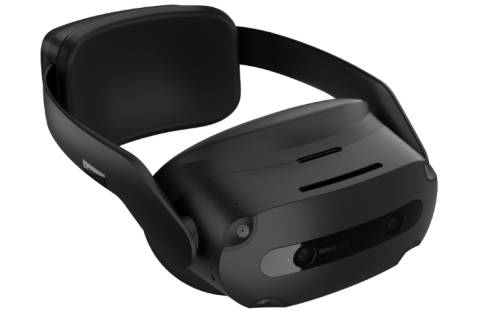
Die Thinkreality VRX ist eine Virtual- respektive Mixed-Reality-Brille, die Lenovo spezifisch als All-in-one-Lösung für Unternehmen entwickelt hat. Zu ihren Features gehört ein hochauflösender Pass-Through-Modus, in dem über die Frontkameras «in die Realität» geblickt werden kann. Dadurch werden neben VR zusätzlich auch AR-Anwendungsfälle möglich.
Einfacher Einstieg ins Enterprise Metaverse
Zu den Leistungen der neuen Brille gehört laut Lenovo auch ein breites Angebot an End-to-End-Services, die den Einstieg ins Enterprise Metaverse so einfach und sicher wie möglich machen sollen. Dazu gehören gemäß dem Hersteller die Beratung, Erstellung von Inhalten bis hin zur Cloud-Bereitstellung und der Kundensupport.
Zusätzlich gibt es die integrierte Thinkreality Software-Plattform, die bei der Verwaltung und dem Monitoring der vom Unternehmen eingesetzten VR- und AR-Lösungen zum Einsatz kommen soll.
Das Headset verfügt neben speziellen Pancake-Linsen über einen Snapdragon-Chip, der für die benötigte Rechenleistung sorgt.
Lenovo beschreibt die Thinkreality VRX als: «Die VR-Lösung für alle Mitarbeitenden».
Die Thinkreality VRX soll Anfangs 2023 auf den Markt kommen, ihr Stückpreis wurde noch nicht bekanntgegeben.


This looks like a significant step forward for enterprise-grade XR. The focus on an end-to-end solution with consulting, content creation, and platform management is exactly what businesses need to adopt this technology effectively, moving beyond niche prototypes to scalable solutions.
The mention of the high-resolution pass-through mode and the Snapdragon chip is particularly interesting. This level of performance requires not just sophisticated software but also robust, reliable hardware engineering. It reminds me of the critical role a stable power foundation plays in any high-performance system.
While the headset itself is undoubtedly designed for energy efficiency, the ecosystem that supports it—from the workstations that create the content to the servers deploying it via the cloud—demands significant and unwavering power. Running a full-scale enterprise metaverse operation is akin to powering a high-performance computing setup; it requires a resilient infrastructure.
This is where the principle of a high-capacity, reliable power supply becomes a perfect metaphor. You wouldn’t try to run a advanced rendering farm or a critical server on a minimal power unit. You’d ensure it had a robust 600-Watt power supply https://serverorbit.com/power-supplies/switches-power/600-watt —or much more—with efficient switching regulation to provide clean, stable power without any fluctuations or drops. That ensures peak performance and, crucially, protects the valuable hardware from damage.
In the same way, Lenovo’s ThinkReality VRX isn’t just a headset; it’s the end-point of a powerful, well-designed ecosystem. Its success will depend on the seamless, stable, and powerful „current“ of data, software, and services flowing to it, much like a GPU depends on clean power from a trusted PSU. The headset is the display, but the enterprise metaverse runs on the entire system’s uninterrupted „wattage.“ Looking forward to seeing more specs and the price point.